Thursday, August 6, 2015
Wisconsin vs Alabama preview
It's up at SB Nation. Much more to come on Alabama and their updated offense in the weeks to come. I think Saban is doing an impressive rebuild there of their roster and overall strategy but I'm not sure if they can survive their losses from 2014 on offense and beat what could be a very good Badgers team.

How Texas will build around Malik
Texas recruited a player in Malik Jefferson with the speed of a cornerback, the power of a DL, and the blitzing ability of a star linebacker. When I noted the rise of the elite athlete at inside linebacker I described guys like Malik as players that may have played as running backs in the past but really he's a freak box safety/OLB hybrid of the likes that football has rarely seen. Evil Roy of Oklahoma is probably one of his closer comps.
He can have value for Texas by being able to take on a wide variety of assignments from an inside linebacker position. Read about it at Inside Texas.
He can have value for Texas by being able to take on a wide variety of assignments from an inside linebacker position. Read about it at Inside Texas.
Wednesday, August 5, 2015
The Seth Russell edition of the Baylor offense
Some thoughtful person calling himself John Hawkins edited all of Seth Russell's snaps from 2014 into one 19 minute video which can be viewed here. Russell played a ton of snaps over the course of the season and not just garbage snaps. He had to beat Northwestern State on his own (I know, I know) and was entrusted with protecting a lead against a furious Texas Tech comeback attempt when Petty got concussed.
He even got a couple of snaps against West Virginia for some reason that I can't remember when Baylor was down and trying to comeback.
Russell got enough snaps for us to be able to make a few solid conclusions about who he is as a QB and player and what the Seth Russell edition of the "veer and shoot" offense will look like.
Art Briles often liked to talk about Bryce Petty as though he was this freakish athlete who could just as easily have been a star at defensive end or linebacker as he was at QB. He was frequently credited with being able to run a 4.6 at 6'3" 230.
This athleticism was never particularly evident on the playing field however and Petty was rarely used as a runner (in comparison to previous Baylor QBs) and wasn't terribly effective when he was.
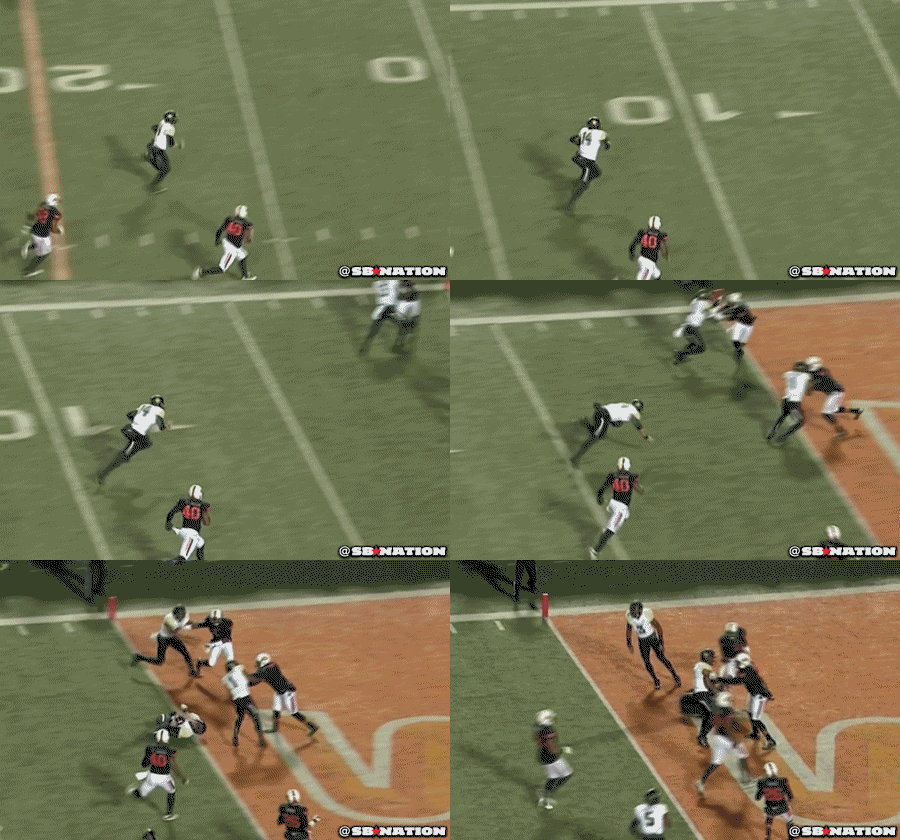
While his combine numbers of a 4.87 40 and 4.13 shuttle were reasonably solid (the latter number is actually incredible, and frankly quite shocking) he didn't seem to actually have much quickness in taking the edge or getting up to speed from a standstill in the shotgun. Perhaps he was playing hurt much more frequently than it was let on, who knows? Whatever the case, he didn't add much dynamics to the Baylor run game.
Seth Russell is a different animal, he's quick to the edge and he has another gear when he hits the open field. Whenever he entered the game Baylor brought back their favorite play from the Nick Florence/Lache Seastrunk offense, the power-read:
 I drew it up here as Baylor ran the play against the SMU Mustangs. The idea is to leave the DE or OLB to the playside unblocked and account for him via the option. If he goes wide to stop the running back sweep the QB keeps the ball and runs behind the pulling guard. If he stays home to stop the QB, then the RB can get wide on the defense and look to run over or around some DBs.
Gus Malzahn popularized this play with Cam Newton but Baylor ran it reasonably well with Nick Florence and TCU used to do nice damage on this concept with Andy Dalton at the helm.
The trick with this play is that it requires a tough QB who's willing and able to take shots from a linebacker or a safety, he needn't necessarily be that quick although it sure doesn't hurt. Russell is "only" 205 but he's a tough runner who can actually cut the run back against the grain and find openings.
Russell's tape in 2014 also shows him running zone read and QB draw effectively. He looks like he might be a 4.7 guy or faster, he's almost as quick as Colt McCoy moving laterally out of the pocket with perhaps an extra gear to pull away thanks no doubt to having long legs (6'3") that chew up yards quickly when they get going.
Seth Russell is a dangerous scrambler who throws pretty well on the run but...well we'll get into some of his deficiencies in the next section.
Russell has a strong arm and a quick release, both of which are immensely valuable in the Baylor system. While Briles' "veer and shoot" offense makes reads simpler for the QB and sets him up for ridiculous statistical seasons, the wide spacing of the wide receivers doesn't do him any favors against an effective pass rush and it requires that he make quick throws with good velocity.
You'll never see a QB with a weak arm thrive in this offense, he'd get picked off trying to throw the field bubble screen. So, Russell definitely has that going for him, between his arm and his legs he's got the tools to operate every part of the Baylor offense that we've seen as of yet.
Because of his quick release and his familiarity with the offense, Russell has already proven he can operate Baylor's RPO offense quite well. These concepts are a God-send for smashmouth spread offenses that want to emphasize passing acumen at QB so they can hit homeruns with the vertical passing game but can't always find dual-threat QBs that excel as passers and runners.
The RPO constrains the anti-spread run game by punishing them for bringing numbers to stop the run with a QB option to throw a quick pass into the zone or assignment area that should have been handled by the extra run defender.
Russell's quick release and ability to throw without always having his feet set make him effective on these concepts and he also seems totally comfortable reading the conflict defenders:
The big questions are whether he can throw with anticipation and accuracy, and what he does when teams are actually able to take away his easy reads. As infrequently as that happens, it happens often enough to impact Baylor's goal of winning the Big 12 championship and trying to get into the playoff.
Oklahoma State looms as at least one team that could muck up the works for Russell with their secondary, and while TCU has struggled some with Baylor's offense they've also had success confusing its quarterbacks into throwing game-deciding interceptions. If Texas finds an offense throw them into that discussion as well, ditto West Virginia if they find a pass-rush.
The 2014 film sheds some light on how Russell might answer the two big questions, "can he throw with anticipation" and "what does he do under duress?" He's likely to improve in both facets after an offseason of receiving first team reps but he's not just raw, unmolded clay. His existing tape can still tell us what his potential might look like.
2014 was a mixed bag for Seth in throwing the vertical routes that really make the Baylor offense go. The idea with these concepts is that the QB needs to identify the deep coverage and then throw while anticipating where his receiver is going to break to find open grass. RG3 sometimes struggled, believe it or not, to throw these routes and instead preferred to wait for the receiver to break open before throwing the ball.
He could make that work, because he could buy time in the pocket with his ludicrous speed and throw the ball 40+ yards downfield and hit a moving target without first setting his feet:
For the less athletically gifted QBs that have followed RG3, it's been more important to be able to throw the ball where you believe the WR is breaking. Seth Russell is probably the closest Baylor has come to RG3 in terms of ability to move around in the pocket and throw on the run, but when he's tried to push the ball down the field while doing this he often makes questionable decisions:
He even got a couple of snaps against West Virginia for some reason that I can't remember when Baylor was down and trying to comeback.
Russell got enough snaps for us to be able to make a few solid conclusions about who he is as a QB and player and what the Seth Russell edition of the "veer and shoot" offense will look like.
Seth Russell the runner
Art Briles often liked to talk about Bryce Petty as though he was this freakish athlete who could just as easily have been a star at defensive end or linebacker as he was at QB. He was frequently credited with being able to run a 4.6 at 6'3" 230.
This athleticism was never particularly evident on the playing field however and Petty was rarely used as a runner (in comparison to previous Baylor QBs) and wasn't terribly effective when he was.
While his combine numbers of a 4.87 40 and 4.13 shuttle were reasonably solid (the latter number is actually incredible, and frankly quite shocking) he didn't seem to actually have much quickness in taking the edge or getting up to speed from a standstill in the shotgun. Perhaps he was playing hurt much more frequently than it was let on, who knows? Whatever the case, he didn't add much dynamics to the Baylor run game.
Seth Russell is a different animal, he's quick to the edge and he has another gear when he hits the open field. Whenever he entered the game Baylor brought back their favorite play from the Nick Florence/Lache Seastrunk offense, the power-read:

Gus Malzahn popularized this play with Cam Newton but Baylor ran it reasonably well with Nick Florence and TCU used to do nice damage on this concept with Andy Dalton at the helm.
The trick with this play is that it requires a tough QB who's willing and able to take shots from a linebacker or a safety, he needn't necessarily be that quick although it sure doesn't hurt. Russell is "only" 205 but he's a tough runner who can actually cut the run back against the grain and find openings.
Russell's tape in 2014 also shows him running zone read and QB draw effectively. He looks like he might be a 4.7 guy or faster, he's almost as quick as Colt McCoy moving laterally out of the pocket with perhaps an extra gear to pull away thanks no doubt to having long legs (6'3") that chew up yards quickly when they get going.
Seth Russell is a dangerous scrambler who throws pretty well on the run but...well we'll get into some of his deficiencies in the next section.
Seth Russell the passer
Russell has a strong arm and a quick release, both of which are immensely valuable in the Baylor system. While Briles' "veer and shoot" offense makes reads simpler for the QB and sets him up for ridiculous statistical seasons, the wide spacing of the wide receivers doesn't do him any favors against an effective pass rush and it requires that he make quick throws with good velocity.
You'll never see a QB with a weak arm thrive in this offense, he'd get picked off trying to throw the field bubble screen. So, Russell definitely has that going for him, between his arm and his legs he's got the tools to operate every part of the Baylor offense that we've seen as of yet.
Because of his quick release and his familiarity with the offense, Russell has already proven he can operate Baylor's RPO offense quite well. These concepts are a God-send for smashmouth spread offenses that want to emphasize passing acumen at QB so they can hit homeruns with the vertical passing game but can't always find dual-threat QBs that excel as passers and runners.
The RPO constrains the anti-spread run game by punishing them for bringing numbers to stop the run with a QB option to throw a quick pass into the zone or assignment area that should have been handled by the extra run defender.
Russell's quick release and ability to throw without always having his feet set make him effective on these concepts and he also seems totally comfortable reading the conflict defenders:
The big questions are whether he can throw with anticipation and accuracy, and what he does when teams are actually able to take away his easy reads. As infrequently as that happens, it happens often enough to impact Baylor's goal of winning the Big 12 championship and trying to get into the playoff.
Oklahoma State looms as at least one team that could muck up the works for Russell with their secondary, and while TCU has struggled some with Baylor's offense they've also had success confusing its quarterbacks into throwing game-deciding interceptions. If Texas finds an offense throw them into that discussion as well, ditto West Virginia if they find a pass-rush.
The 2014 film sheds some light on how Russell might answer the two big questions, "can he throw with anticipation" and "what does he do under duress?" He's likely to improve in both facets after an offseason of receiving first team reps but he's not just raw, unmolded clay. His existing tape can still tell us what his potential might look like.
2014 was a mixed bag for Seth in throwing the vertical routes that really make the Baylor offense go. The idea with these concepts is that the QB needs to identify the deep coverage and then throw while anticipating where his receiver is going to break to find open grass. RG3 sometimes struggled, believe it or not, to throw these routes and instead preferred to wait for the receiver to break open before throwing the ball.
He could make that work, because he could buy time in the pocket with his ludicrous speed and throw the ball 40+ yards downfield and hit a moving target without first setting his feet:
For the less athletically gifted QBs that have followed RG3, it's been more important to be able to throw the ball where you believe the WR is breaking. Seth Russell is probably the closest Baylor has come to RG3 in terms of ability to move around in the pocket and throw on the run, but when he's tried to push the ball down the field while doing this he often makes questionable decisions:
You notice the amazing ability here when Russell pump fakes, holds onto the ball in a collapsing pocket, and then escapes but then you notice how off the throw is and how poor the decision was to attempt it.
Over and over again on tape you see Russell exhibit some fearlessness when he's throwing the football but in the Baylor system that can be dangerous when the QB is pressured and all of his targets are a mile away downfield. The two things Russell will need to iron down to please Briles this offseason will be making sure he doesn't miss the open touchdown passes that will inevitably be available to Coleman, Cannon, and co. and avoiding turning the ball over when under duress.
Seth, if you don't have a guy coming back to you then either scramble or throw it away.
Russell was good enough at hitting open receivers on deep routes in stride in 2014 to suspect that he might be great at it in 2015.
Prognosis for the 2015 Baylor offense
Seth Russell is a better runner than Petty, a capable deep ball thrower on a team with a lot of deep ball weapons, and a strong practitioner of the RPO game. When you combine those skills with a team that is returning the entire offensive line, three good running backs, two massive tight ends, and the best WR corps in the conference it's hard not to expect big things.
In particular, it seems that it'll be very difficult to stop either the Baylor running game or their play-action vertical tosses. However, it could all be undone if Russell doesn't learn to read defenses and avoid mistakes.
Bryce Petty threw only 10 interceptions in two seasons as a starter, that's what is possible in this system and that's what it's taken to win back to back Big 12 championships. It sometimes appears as though Briles could train a monkey to throw for 4k yards in this offense but unless Russell can do that without turnovers then that production may not hold off TCU or Oklahoma State from stealing the title belt.
Monday, August 3, 2015
West Virginia: A 2015 darkhorse Big 12 contender?
The West Virginia Mountaineers are pretty easy to overlook heading into 2015. Their QB Clint Trickett is gone as are his two leading receivers, Kevin White and Mario Alford, who had 1147 yards and 10 TDs and 945 yards and 11 touchdowns respectively.
The Mountaineers also lose their leading pass-rusher Shaq Riddick, who had 11 tackles for loss and seven sacks a year ago.
Four big pieces from a team that was 7-6 last year.
Perhaps the most concerning facet of the 2015 West Virginia football team is that they have to play games in Norman, Waco, Ft. Worth, and Manhattan. It'd be harder to put together a more difficult Big 12 road slate, especially for 2015.
The schedule alone is almost an immediate disqualifier for considering the 'Neers as serious B12 contenders, even if all of those players mentioned above were returning.
However, when you look a little deeper there are some aspects to this team that make them intriguing. There's a chance that even if they can't win the league in 2015 they might spoil someone else's season and even finish with something in the range of 8-10 wins.
Despite their unimpressive win total, WV had a solid S&P ranking of 40 from a year ago. This was a pretty good offensive team and a pretty good defensive team with two defining traits that made them feisty on both sides of the ball.
First, they started Mario Alford and Kevin White opposite of each other as their X and Z receivers. Most Big 12 defenses don't even have a scheme that allows them to double both outside receivers unless they drop eight players into coverage. Nevertheless, most teams probably wanted to double both receivers. Alford ran a 4.43 40 at the combine while Kevin White ran a 4.35 and is 6'3" 215 to boot. These were horrifying match-ups.
Trickett wasn't healthy enough throughout the year to allow them to fully maximize this advantage, but they still did plenty of damage.
Second, everyone in their secondary could play man coverage and tackle reasonably well, which allowed DC Tony Gibson to bring a wide variety of blitzes and have a safety net from their deep coverage. They weren't amazing up front and didn't get as much play-making out of that versatility in the form of sacks and turnovers as you'd hope for, but they were able to do enough to be more than a nuisance to opposing offenses.
There are three defining traits about the 2015 Mountaineers that could make them pretty feisty again in 2015, maybe even strong, maybe even contenders.
They're all back and I have them as the 5th best group in the nation. When you combine playing another year in Tony Gibson's 3-3-5 with likely growth from free safety Karl Joseph you have a recipe for this unit to go from picking off 10 passes in 2014 to as many as 15 or 20 in 2015.
Perhaps what they do best is allow West Virginia to blitz aggressively and make explosive plays difficult for opponents when playing one of their numerous varieties of three-deep coverage.
West Virginia always recruits lots of speed, it's the name of the game for them as their entire offensive system is predicated around getting fast guys in space and allowing them to get to work. Even after graduating two of the fastest receivers in the Big 12 they are confronting opponents in 2015 with two of the faster players at their respective positions.
Shelton Gibson hasn't seen much playing time yet but Dana Holgorsen called him the fastest player he's coached...you might suspect this is just hyperbole since in addition to coaching White and Alford he's also coached Tavon Austin, Justin Blackmon, Wes Welker, and several other Air Raid heroes.
However, take a look at Gibson's hudl and you'll see what appears to at least be another 4.4 type burner if not the absolute speed demon Holgorsen was selling at media days.
Then there's Wendell Smallwood, a very effective back who can also catch the ball out of the backfield. Smallwood ran for 722 yards in 2014 at 4.9 ypc with another 325 yards receiving.
Back-up QB William Crest is apparently going to get in on the action as well as Holgorsen looks to involve his speed in some kind of RB/WR hybrid position. The Holgo-Raid is simple enough that it shouldn't be too hard for them to incorporate all the speed on the roster.
West Virginia can run a wide variety of formations and schemes in 2015 with their personnel but some of them will really put some explosive speed on the field. When you factor in QB Skyler Howard's ability to pose a threat as a runner you can't afford to ignore then you have a team that can really put stress on opponents.
In addition to being able to deploy one of the most athletic skill groups in the entire conference, West Virginia also has some experience returning in the middle of the field. They'll attack the middle of the field on offense with RB Rushel Shell, TE/FB Cody Clay, LG Adam Pankey, and OC Tyler Orlosky who all offer some power and a year of experience.
On defense their LB corps of Kwiatkowski, Barber, and Petteway is one of the most experienced groups in the country and will be playing behind a DL of Christian Brown, Kyle Rose, and Noble Nwachukwu that have also all played a lot of Big 12 football.
In the Big 12 you want to be athletic on the outside and experienced on the inside, West Virginia checks both boxes on both sides of the ball.
There are four questions for this team that will determine if West Virginia can actually make something happen and break through with an eight win season to save Holgorsen's job.
Skyler Howard's one big failing in the bowl contest with A&M was misfiring on some vertical throws that the Aggies left open to the 'Neers. A lot of these types of throws, such as the fade, are just about timing and muscle memory so there's a good chance that Howard will make up ground here in 2015.
Of course, he may not be able to set his feet and nail the timing if WV can't find a left tackle to keep him upright, which they hope to have in Yodny Cajuste.
There's also the question of whether Gibson's speed or Daikiel Shorts' size (6'1") translates to WV having a deep threat with which to make teams pay for trying to load up the box or sending pass-rushers to knock over Howard.
The answer to the blitz last year was pretty straightforward, throw a fade route to Kevin White. The solutions in 2015 may have to be more nuanced.
West Virginia played a wide variety of fronts in 2014, including a "46" style look that used their sam and will linebackers up on the line as edge/contain players while playing "buck" safety Karl Joseph in the box.
Other times they'd drop Joseph as an edge/contain player while shifting their linebackers over to the strongside, their 3-3-5 personnel afford them a great deal of flexibility. The key is finding another OLB opposite Kwiatkowski that can play the edge or in the box as the weakside linebacker.
Ideally they'd find a player that could play as a 9-tech and take the edge, be a player opponents have to account for stunting inside on the blitz, be solid and aware in underneath coverage, and understand how to fit runs between the tackles.
It's a diverse role and West Virginia uses some disguise to set up their LBs for success by allowing them to appear where unexpected and be shielded from targeted by opposing game plans.
Shaq Petteway is the man who's next in line and at 6'0" 230. He's not exactly what you'd picture as the ideal fit but if he can be explosive in the pass-rush and versatile in his skill set he'll have a chance to make a lot of plays in 2015.
With Shaq Riddick gone the biggest question on defense is who will take advantage of the 1-on-1 match-ups afforded by DC Gibson's blitzing schemes. Nose tackle Kyle Rose is more of a space filler who will work to keep their LBs clean and Christian Brown will serve a similar role as a tackle/end.
None of the linebackers necessarily stand out as guys that will contribute a lot of pass-rushing acumen to this team, which leaves the end position vacated by Riddick as the most likely source of play-making.
Nwachukwu had eight tackles for loss and four pass break-ups a year ago and has been praised as being potentially dominant but merely inconsistent, which for a redshirt sophomore was still fairly reasonable. He'll need to finish plays in 2015 and get to the QB, there's really not another solution if he can't do it except to play another DE.
The LBs and DBs already need to finish more pressures on the QB when they blitz before you ask them to also replace Riddick's production. When you also consider how often Gibson relies on a three-man rush it becomes clear that they need a breakthrough from their DL.
If West Virginia can't pair an ability to play aggressive coverages and experienced safeties with pressure on the quarterback they will not achieve their potential to force turnovers in 2015 and their defense may not be as good as it needs to be.
It's hard to imagine West Virginia having the kind of season that would signal a breakthrough without them winning a big game on the road. None of their home game opponents are necessarily high profile enough to really count for much unless Texas or Oklahoma State have big seasons.
Winning on the road requires ball security, team communication, and preparation that are usually marks of a veteran team. West Virginia is that, except at QB where Skyler Howard has not yet experienced what it's like to identify coverages or blitzes while 50k+ fans are screaming at him.
West Virginia will always score points with Dana Holgorsen at the helm. His spread-I/Holgo-Raid offense is great at putting stress on defensive systems and utilizing the speed that he's successfully stockpiled in Morgantown. He's taking on the challenge of coaching the QBs personally to make sure this season goes the way it should for West Virginia.
This is the best defensive personnel he's had since he took over the program, if they can make a leap and play top 25 level defense while Dana reloads the offense this could be a very good team.
If not? Dana might become a hot commodity as an OC hire after West Virginia's new athletic director throws him out. Should be fun to watch, especially for fans of teams with big question marks of their own in their offensive staff.
The Mountaineers also lose their leading pass-rusher Shaq Riddick, who had 11 tackles for loss and seven sacks a year ago.
Four big pieces from a team that was 7-6 last year.
Perhaps the most concerning facet of the 2015 West Virginia football team is that they have to play games in Norman, Waco, Ft. Worth, and Manhattan. It'd be harder to put together a more difficult Big 12 road slate, especially for 2015.
The schedule alone is almost an immediate disqualifier for considering the 'Neers as serious B12 contenders, even if all of those players mentioned above were returning.
However, when you look a little deeper there are some aspects to this team that make them intriguing. There's a chance that even if they can't win the league in 2015 they might spoil someone else's season and even finish with something in the range of 8-10 wins.
Despite their unimpressive win total, WV had a solid S&P ranking of 40 from a year ago. This was a pretty good offensive team and a pretty good defensive team with two defining traits that made them feisty on both sides of the ball.
First, they started Mario Alford and Kevin White opposite of each other as their X and Z receivers. Most Big 12 defenses don't even have a scheme that allows them to double both outside receivers unless they drop eight players into coverage. Nevertheless, most teams probably wanted to double both receivers. Alford ran a 4.43 40 at the combine while Kevin White ran a 4.35 and is 6'3" 215 to boot. These were horrifying match-ups.
Trickett wasn't healthy enough throughout the year to allow them to fully maximize this advantage, but they still did plenty of damage.
Second, everyone in their secondary could play man coverage and tackle reasonably well, which allowed DC Tony Gibson to bring a wide variety of blitzes and have a safety net from their deep coverage. They weren't amazing up front and didn't get as much play-making out of that versatility in the form of sacks and turnovers as you'd hope for, but they were able to do enough to be more than a nuisance to opposing offenses.
There are three defining traits about the 2015 Mountaineers that could make them pretty feisty again in 2015, maybe even strong, maybe even contenders.
Defining Trait 1: That secondary
They're all back and I have them as the 5th best group in the nation. When you combine playing another year in Tony Gibson's 3-3-5 with likely growth from free safety Karl Joseph you have a recipe for this unit to go from picking off 10 passes in 2014 to as many as 15 or 20 in 2015.
Perhaps what they do best is allow West Virginia to blitz aggressively and make explosive plays difficult for opponents when playing one of their numerous varieties of three-deep coverage.
Defining Trait 2: Offensive speed, again
West Virginia always recruits lots of speed, it's the name of the game for them as their entire offensive system is predicated around getting fast guys in space and allowing them to get to work. Even after graduating two of the fastest receivers in the Big 12 they are confronting opponents in 2015 with two of the faster players at their respective positions.
Shelton Gibson hasn't seen much playing time yet but Dana Holgorsen called him the fastest player he's coached...you might suspect this is just hyperbole since in addition to coaching White and Alford he's also coached Tavon Austin, Justin Blackmon, Wes Welker, and several other Air Raid heroes.
However, take a look at Gibson's hudl and you'll see what appears to at least be another 4.4 type burner if not the absolute speed demon Holgorsen was selling at media days.
Then there's Wendell Smallwood, a very effective back who can also catch the ball out of the backfield. Smallwood ran for 722 yards in 2014 at 4.9 ypc with another 325 yards receiving.
Back-up QB William Crest is apparently going to get in on the action as well as Holgorsen looks to involve his speed in some kind of RB/WR hybrid position. The Holgo-Raid is simple enough that it shouldn't be too hard for them to incorporate all the speed on the roster.
West Virginia can run a wide variety of formations and schemes in 2015 with their personnel but some of them will really put some explosive speed on the field. When you factor in QB Skyler Howard's ability to pose a threat as a runner you can't afford to ignore then you have a team that can really put stress on opponents.
Defining Trait 3: Some experience in the middle
In addition to being able to deploy one of the most athletic skill groups in the entire conference, West Virginia also has some experience returning in the middle of the field. They'll attack the middle of the field on offense with RB Rushel Shell, TE/FB Cody Clay, LG Adam Pankey, and OC Tyler Orlosky who all offer some power and a year of experience.
On defense their LB corps of Kwiatkowski, Barber, and Petteway is one of the most experienced groups in the country and will be playing behind a DL of Christian Brown, Kyle Rose, and Noble Nwachukwu that have also all played a lot of Big 12 football.
In the Big 12 you want to be athletic on the outside and experienced on the inside, West Virginia checks both boxes on both sides of the ball.
There are four questions for this team that will determine if West Virginia can actually make something happen and break through with an eight win season to save Holgorsen's job.
Question 1: Can they throw the ball downfield?
Skyler Howard's one big failing in the bowl contest with A&M was misfiring on some vertical throws that the Aggies left open to the 'Neers. A lot of these types of throws, such as the fade, are just about timing and muscle memory so there's a good chance that Howard will make up ground here in 2015.
Of course, he may not be able to set his feet and nail the timing if WV can't find a left tackle to keep him upright, which they hope to have in Yodny Cajuste.
There's also the question of whether Gibson's speed or Daikiel Shorts' size (6'1") translates to WV having a deep threat with which to make teams pay for trying to load up the box or sending pass-rushers to knock over Howard.
The answer to the blitz last year was pretty straightforward, throw a fade route to Kevin White. The solutions in 2015 may have to be more nuanced.
Question 2: Who steps up on the weakside?
West Virginia played a wide variety of fronts in 2014, including a "46" style look that used their sam and will linebackers up on the line as edge/contain players while playing "buck" safety Karl Joseph in the box.
Other times they'd drop Joseph as an edge/contain player while shifting their linebackers over to the strongside, their 3-3-5 personnel afford them a great deal of flexibility. The key is finding another OLB opposite Kwiatkowski that can play the edge or in the box as the weakside linebacker.
Ideally they'd find a player that could play as a 9-tech and take the edge, be a player opponents have to account for stunting inside on the blitz, be solid and aware in underneath coverage, and understand how to fit runs between the tackles.
It's a diverse role and West Virginia uses some disguise to set up their LBs for success by allowing them to appear where unexpected and be shielded from targeted by opposing game plans.
Shaq Petteway is the man who's next in line and at 6'0" 230. He's not exactly what you'd picture as the ideal fit but if he can be explosive in the pass-rush and versatile in his skill set he'll have a chance to make a lot of plays in 2015.
Question 3: Is there an impact player on the defensive line?
With Shaq Riddick gone the biggest question on defense is who will take advantage of the 1-on-1 match-ups afforded by DC Gibson's blitzing schemes. Nose tackle Kyle Rose is more of a space filler who will work to keep their LBs clean and Christian Brown will serve a similar role as a tackle/end.
None of the linebackers necessarily stand out as guys that will contribute a lot of pass-rushing acumen to this team, which leaves the end position vacated by Riddick as the most likely source of play-making.
Nwachukwu had eight tackles for loss and four pass break-ups a year ago and has been praised as being potentially dominant but merely inconsistent, which for a redshirt sophomore was still fairly reasonable. He'll need to finish plays in 2015 and get to the QB, there's really not another solution if he can't do it except to play another DE.
The LBs and DBs already need to finish more pressures on the QB when they blitz before you ask them to also replace Riddick's production. When you also consider how often Gibson relies on a three-man rush it becomes clear that they need a breakthrough from their DL.
If West Virginia can't pair an ability to play aggressive coverages and experienced safeties with pressure on the quarterback they will not achieve their potential to force turnovers in 2015 and their defense may not be as good as it needs to be.
Question 4: Can this team win on the road?
It's hard to imagine West Virginia having the kind of season that would signal a breakthrough without them winning a big game on the road. None of their home game opponents are necessarily high profile enough to really count for much unless Texas or Oklahoma State have big seasons.
Winning on the road requires ball security, team communication, and preparation that are usually marks of a veteran team. West Virginia is that, except at QB where Skyler Howard has not yet experienced what it's like to identify coverages or blitzes while 50k+ fans are screaming at him.
West Virginia will always score points with Dana Holgorsen at the helm. His spread-I/Holgo-Raid offense is great at putting stress on defensive systems and utilizing the speed that he's successfully stockpiled in Morgantown. He's taking on the challenge of coaching the QBs personally to make sure this season goes the way it should for West Virginia.
This is the best defensive personnel he's had since he took over the program, if they can make a leap and play top 25 level defense while Dana reloads the offense this could be a very good team.
If not? Dana might become a hot commodity as an OC hire after West Virginia's new athletic director throws him out. Should be fun to watch, especially for fans of teams with big question marks of their own in their offensive staff.
Thursday, July 30, 2015
What can Louisville vs Auburn tell us about Baylor vs TCU?
I broke down Louisville and Auburn's week 1 match-up over at SB Nation.
One thing I talk about in that article is the "Blue-Sky" defense that TCU loves so much and which has frequently been ripped apart by Baylor's passing game. Louisville used that same defense, which uses the nickel and boundary safety as run-force players while asking the corners and free safety to play deep, to great effect last year.
Gerod Holiman had something like 27 interceptions playing as a free safety while James Sample led the Cardinals with 90 tackles playing in the run-support role. It's a great defense if the other team can't make you pay with the passing game.
You figure Josh Harvey-Clemons will now step into that boundary safety position and be primarily responsible for helping Louisville stop Auburn's run game. The big question will be, can Auburn's new passing quarterback make the Cardinal corners and free safety pay as Baylor frequently does against TCU?
It'll also be interesting to see if Cardinal DC Todd Grantham takes note of what smashmouth spread strategies have done to TCU's version of the defense and maybe adjusts his plan this year or carries a back-up plan in the event that Malzahn mimics the Baylor method for attacking the coverage.
Which Longhorns benefit the most from Texas' move to the spread?
Texas moved to the spread to better capture what's happening in high school football across the state and to make it easier to utilize the athletes they already have on the roster. But which ones stand to benefit the most, and which players are getting a tougher draw as a result of the schematic changes?
Read about it at Inside Texas.
Read about it at Inside Texas.
Wednesday, July 29, 2015
Dispelling the myth that wide hash marks help college offenses
They don't.
And those hash marks, amongst other factors, are going to complicate things for college spread passing attacks that want to emulate the success of the Patriots. Read all about it over at Football Study Hall.
And those hash marks, amongst other factors, are going to complicate things for college spread passing attacks that want to emulate the success of the Patriots. Read all about it over at Football Study Hall.
Subscribe to:
Posts (Atom)